
NRSur7dq4v2: A multi-domain precessing surrogate model with improved accuracy
Abhishek Ravishankar, Vijay Varma, Scott E. Field, Keefe Mitman, Nils Deppe, Leo C. Stein, Michael Boyle, Mark A. Scheel
[arXiv:2609.07873]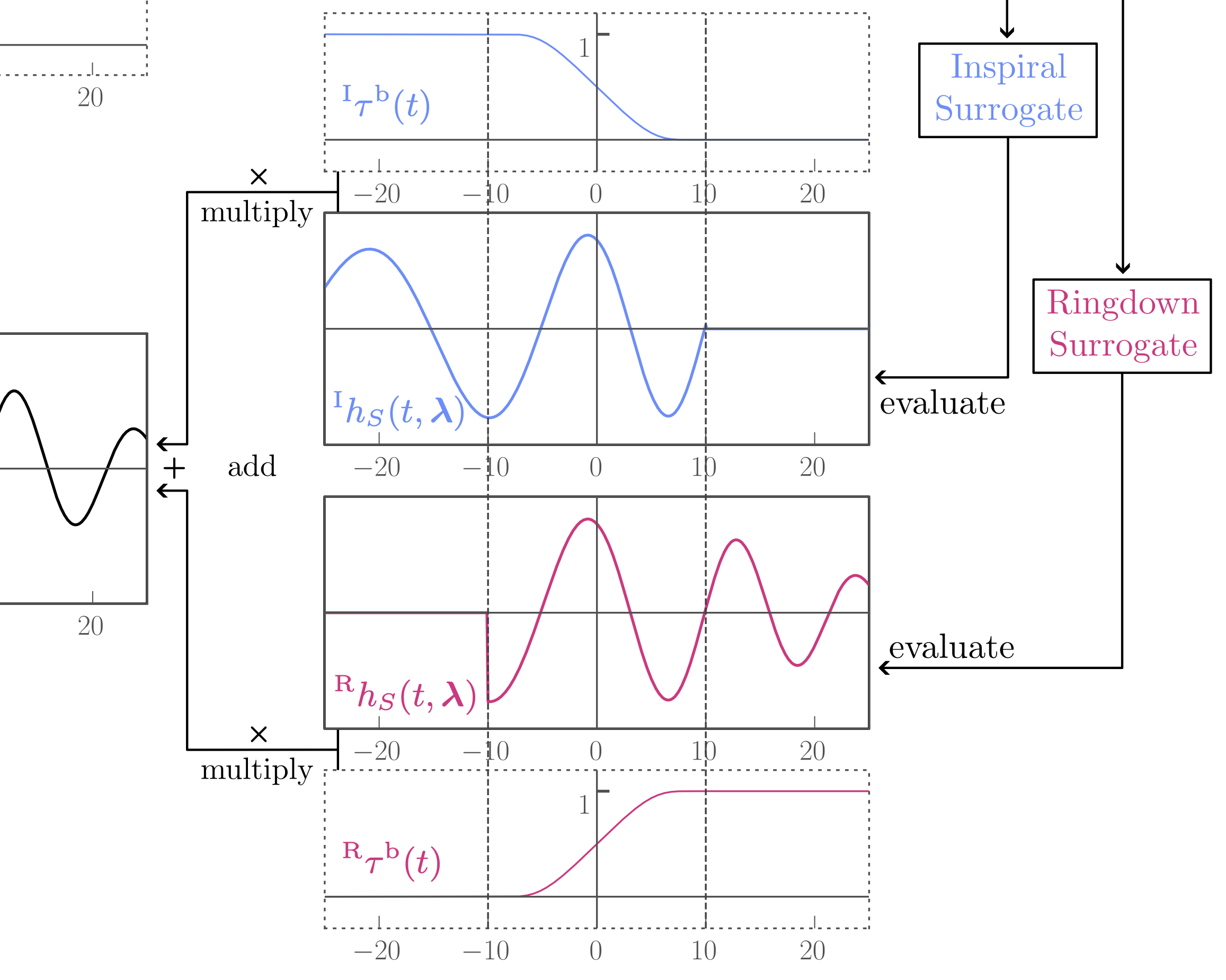
Numerical relativity simulations provide the most accurate waveforms for binary black hole coalescences, but are prohibitively expensive for direct use in gravitational-wave data analysis. Surrogate models overcome this cost, and NRSur7dq4 is commonly used in parameter estimation for this reason. However, there is evidence in the literature that NRSur7dq4’s accuracy could be improved in the merger-ringdown portion of the waveform, which is particularly important for the analysis of high-mass binary black hole events. Motivated by these observations, we construct NRSur7dq4v2, a multi-domain extension of NRSur7dq4 in which overlapping temporal subdomains allow tighter, independent error control over the inspiral and merger-ringdown portions of the waveform before they are smoothly combined. To assess the new model’s performance in the merger-ringdown regime, we infer the mass and spin of the remnant black hole from quasi-normal fits to the ringdown portion of the surrogate waveform. We find that NRSur7dq4v2 produces significantly improved remnant mass and spin estimates, with gains of roughly factors of to over NRSur7dq4. Compared to NRSur7dq4, NRSur7dq4v2 also includes modes up to , includes more accurate modeling of certain subdominant modes, and introduces a runtime model-complexity feature that gives users direct control over the tradeoff between evaluation cost and accuracy. Finally, alongside the model development, we have optimized the gwsurrogate package to achieve a fourfold speedup for precessing surrogates. The resulting precessing surrogates called through gwsurrogate are now slightly faster than their LALSimulation counterparts.